

How Long Does Percocet Stay in Your System?
If you take Percocet for pain, or you are worried about someone who does, it is common to ask “How long does Percocet stay in your system?” You might be concerned about safety, driving, drug testing, or the possibility that use is getting out of control.
Percocet is a brand name for a combination of oxycodone and acetaminophen, used to treat moderate to severe pain when other options are not enough. Oxycodone is a powerful opioid, and even when prescribed, it carries a real risk of tolerance, dependence, and addiction.
How long Percocet stays in your system depends on:
- How much you take and how often
- Your age, weight, and metabolism
- Liver and kidney function
- The type of drug test being used
Below is a clear breakdown of how Percocet works in the body, typical half life, detection windows, and what to do if you are concerned about misuse. Because Percocet contains oxycodone, its detection timeline is very similar to other opioids. For a broader overview, you can also review our guide on how long opioids stay in your system.
What Is Percocet and How Does It Work?
Percocet combines:
- Oxycodone, an opioid pain reliever that changes how the brain and nervous system respond to pain
- Acetaminophen, a less potent pain reliever that can boost oxycodone’s pain-relieving effects
It is prescribed for pain that is severe enough to require an opioid and when other non opioid options are not effective or tolerated.
For a patient friendly overview of oxycodone, effects, and serious safety warnings, it is helpful to see the MedlinePlus oxycodone drug information page from the U.S. National Library of Medicine.
When you swallow Percocet:
- It is absorbed through the digestive system.
- Oxycodone is processed mainly in the liver and then circulated in the bloodstream.
- Both oxycodone and acetaminophen are broken down and eventually excreted in the urine.
You can learn more about the opioid component in our article on how long oxycodone stays in your system.
Percocet Half Life and How Long It Stays in Your System
A drug’s half life is the time it takes for the body to remove half of the active substance from the bloodstream.
- The average elimination half life of oxycodone in Percocet is about 3.5 hours.
- It usually takes around 4 to 5 half lives for most of a dose to be cleared.
This means that in many healthy adults:
-
Most of a single dose of Percocet is eliminated from the bloodstream in roughly 17 to 18 hours.
However, drug tests can detect oxycodone for longer than the simple blood half life suggests, especially with regular or heavy use.
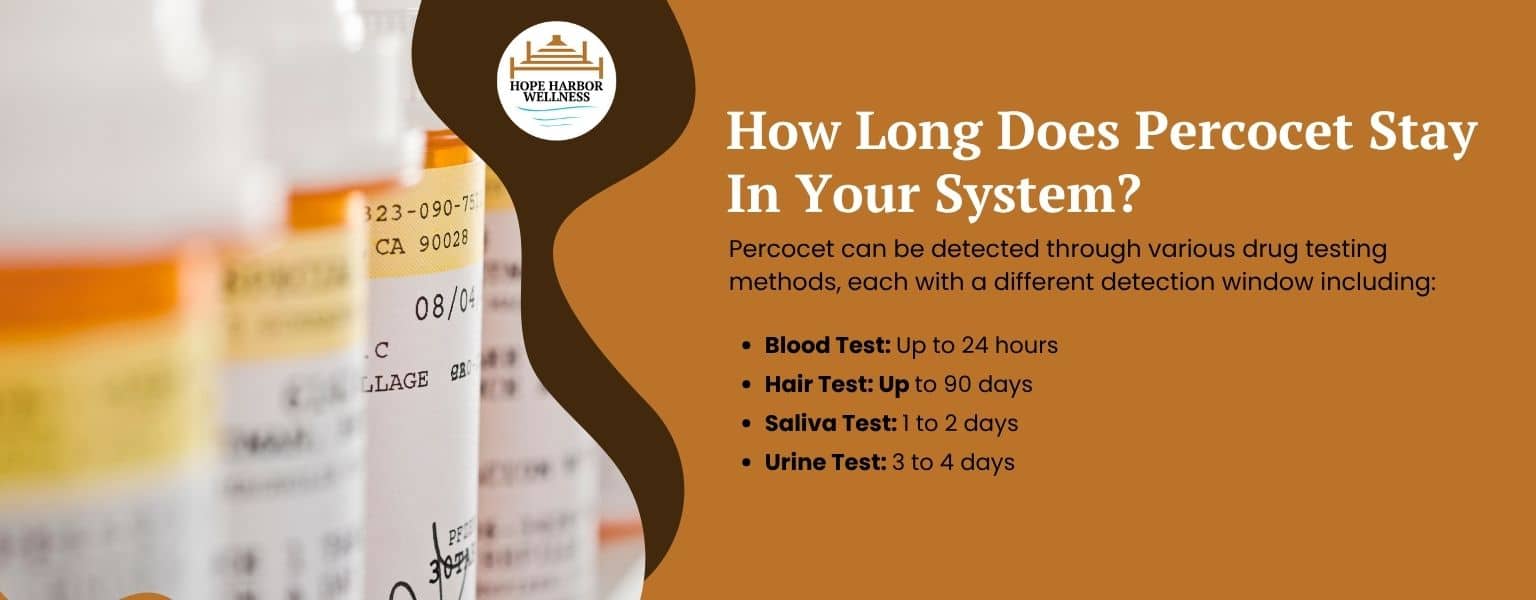
How Long Does Percocet Stay in Your System for Drug Tests?
Exact detection times vary from person to person and depend on the sensitivity of the test, but general estimates for oxycodone are:
Blood
-
Oxycodone from Percocet is usually detectable in blood for about up to 24 hours after the last dose in most people.
Urine
- In urine, oxycodone is often detectable for about 1 to 3 days after the last use.
- Heavy or chronic use may extend the window to around 3 to 4 days for some individuals.
Saliva
-
Oxycodone can appear in saliva quickly, often within minutes, and may be detectable for up to 1 to 2 days.
Hair
-
Hair tests have the longest window. Traces of oxycodone use may show up in hair for up to 90 days or more, depending on hair length and growth.
These are typical ranges, not guarantees. Factors like dose, duration of use, body composition, and overall health all influence detection.
Factors That Affect How Long Percocet Stays in Your System
Percocet does not leave everyone’s body at the same rate.
Important factors include:
- Dose and frequency: Higher doses and frequent dosing can raise blood levels and extend how long oxycodone is detectable.
- Length of use: Long term or heavy use can cause the drug to accumulate in tissues, sometimes leading to slightly longer detection windows.
- Age: Older adults often clear medications more slowly.
- Liver and kidney function: Since oxycodone and acetaminophen are metabolized in the liver and excreted by the kidneys, any impairment in these organs can slow elimination.
- Overall health and metabolism: Hydration, body weight, and metabolic rate all play a role.
- Other medications and substances: Certain medicines and alcohol can affect how the body processes Percocet, and can also increase risks for side effects and overdose.
Does Percocet Show Up on a Drug Test?
Yes. Percocet contains oxycodone, and many standard drug tests screen specifically for oxycodone or other opioids.
- Standard urine panels for employment or legal purposes often include an oxycodone assay or a broader opioid screen.
- More specialized testing in hospitals or treatment programs can confirm the presence and concentration of oxycodone and its metabolites.
Drug test panels vary, so if you have a specific concern, it is best to ask which substances are included in the test.

Factors That Affect How Long Percocet Stays in Your System
Percocet does not leave everyone’s body at the same rate. Important factors include:
- Dose and frequency: Higher doses and frequent dosing can raise blood levels and extend how long oxycodone is detectable.
- Length of use: Long term or heavy use can cause the drug to accumulate in tissues, sometimes leading to slightly longer detection windows.
- Age: Older adults often clear medications more slowly.
- Liver and kidney function: Since oxycodone and acetaminophen are metabolized in the liver and excreted by the kidneys, any impairment in these organs can slow elimination.
- Overall health and metabolism: Hydration, body weight, and metabolic rate all play a role.
- Other medications and substances: Certain medicines and alcohol can affect how the body processes Percocet, and can also increase risks for side effects and overdose.
Does Percocet Show Up on a Drug Test?
Yes. Percocet contains oxycodone, and many standard drug tests screen specifically for oxycodone or other opioids.
- Standard urine panels for employment or legal purposes often include an oxycodone assay or a broader opioid screen.
- More specialized testing in hospitals or treatment programs can confirm the presence and concentration of oxycodone and its metabolites.
Drug test panels vary, so if you have a specific concern, it is best to ask which substances are included in the test.
Why People Worry About How Long Percocet Stays in Their System
Sometimes the question is purely practical, for example when someone has a legitimate prescription and is worried about workplace policies. Other times, the question points to deeper issues:
- Taking Percocet in higher doses than prescribed
- Using it more often than directed
- Taking someone else’s prescription
- Combining Percocet with alcohol, benzodiazepines, or other drugs
- Feeling unable to cope without it
When that is the case, it may be less about drug testing and more about concerns that use has crossed the line into misuse or addiction.
The National Institute on Drug Abuse (NIDA) Prescription Opioids DrugFacts page explains how opioids like oxycodone affect the brain and why they can be so habit forming, even when they start as a legitimate prescription.
Is Percocet Addictive?
Yes. Because Percocet contains oxycodone, it has a high potential for misuse and addiction. Over time, your brain can become dependent on opioid effects.
You may:
- Need higher doses to get the same pain relief
- Feel unwell or anxious between doses
- Find it difficult to cut back without withdrawal symptoms
- Continue taking Percocet even when it harms your health, relationships, or finances
If you notice these signs, you may be dealing with an opioid use disorder rather than just physical dependence. To learn more on Percocet withdrawal and opioid withdrawal and what to expect when stopping opioids and why medical support matters.
Risks of Percocet Misuse
Misusing Percocet can quickly become dangerous. Risks include:
- Overdose: Taking too much oxycodone can slow or stop breathing. Mixing Percocet with other depressants such as alcohol or benzodiazepines greatly increases this risk.
- Liver damage: Acetaminophen in Percocet can be toxic to the liver at high doses, especially when combined with other acetaminophen containing products or alcohol.
- Dependence and addiction: Over time, the brain adapts to the presence of opioids, leading to tolerance and dependence. People may feel withdrawal symptoms when they try to cut back or stop.
- Withdrawal symptoms: Symptoms can include muscle aches, sweating, nausea, diarrhea, anxiety, and intense cravings.
The FDA approved medication guide for PERCOCET on DailyMed outlines boxed warnings about addiction, abuse, misuse, and overdose, reinforcing that this medication should only be used exactly as directed under medical supervision.
When Concern About Percocet Points to a Bigger Problem
You might be asking how long Percocet stays in your system because you:
- Are afraid of a positive drug test
- Are taking more pills than prescribed
- Are using Percocet that was not prescribed for you
- Feel sick, anxious, or restless when you do not have it
- Notice that pain and cravings occupy more of your day
These can be signs that it is time to talk with someone who understands opioid use, pain, and mental health.
You do not need to wait until you lose everything. Reaching out early can protect your health, your relationships, and your future.
Can You Speed Up Percocet Detox?
Plenty of myths circulate about “flushing” Percocet out of your system with water, detox drinks, or home remedies. These methods do not reliably change detection times and can be unsafe if they involve extreme fluid intake or unregulated supplements.
What does help:
- Stopping Percocet under medical supervision
- Staying hydrated and eating regularly
- Getting medical help if you develop withdrawal symptoms such as chills, muscle aches, nausea, anxiety, or insomnia
Trying to manage opioid withdrawal on your own can be risky and very uncomfortable. When you are ready to stop Percocet, professional support makes a major difference.
More About Drug Tests and Detection
Understanding how long Percocet stays in your system is only one piece of the picture. If you’d like a deeper breakdown of how urine, blood, saliva, and hair tests actually work, you can read our guide on how drug tests work. For a broader overview of different substances and timelines, visit how long drugs stay in your system.
Percocet Addiction Treatment at Hope Harbor Wellness
At Hope Harbor Wellness in Georgia, we recognize that opioid use rarely exists in a vacuum.
Many of our clients are dealing with:
- Misuse of medications like Percocet, Vicodin, or other opioids
- Long standing pain conditions
- Anxiety, depression, trauma, or other mental health concerns
- Stress in relationships, work, or school
We offer outpatient levels of care that help you step away from substance use and rebuild a safer, more stable life.
- Outpatient detox support, with medication when appropriate
- Partial Hospitalization Program (PHP) for full-day structure without inpatient stay
- Intensive Outpatient Program (IOP) for flexible but intensive treatment
- Outpatient care, relapse-prevention planning, and continued support
- Dual-diagnosis treatment for both substance use and mental health conditions
Treatment may include:
- Individual and group therapy
- Trauma-informed care
- Family sessions and education
- Medication-assisted treatment when clinically appropriate
- Holistic supports that help you rebuild routines, sleep, and physical health
We work with you, not against you, to help you move away from the cycle of injecting and toward a safer, healthier life.
You are not a bad person for struggling with Percocet. You are a person who deserves help.
Call us today at 770-573-9546 or fill out our online contact form.—let’s map a plan that fits your life and protects your health.
FAQs: How Long Does Percocet Stay in Your System?
How long does Percocet stay in your system?
In many healthy adults, most of a single dose of Percocet is cleared from the bloodstream in about 17 to 18 hours, based on an average oxycodone half life of 3.5 hours. However, traces of oxycodone can remain detectable in urine, saliva, and hair for longer periods.
How long is Percocet detectable in urine?
Percocet, through its oxycodone component, is often detectable in urine for about 1 to 3 days after the last dose. Heavy or long term use can extend that window up to around 3 to 4 days for some people.
Will Percocet show up on a standard drug test?
Yes. Most standard drug screens include opioids, and many specifically test for oxycodone. If you are taking Percocet as prescribed, you should disclose this to the testing provider.
Can anything make Percocet leave your system faster?
There is no safe shortcut to “flush” Percocet from your body. Hydration, good nutrition, and time allow your liver and kidneys to do their job. Trying to speed things up with extreme methods or other substances can be dangerous.
Is Percocet more addictive than other pain medications?
Percocet contains oxycodone, a powerful opioid with a well documented risk of addiction, even when used as prescribed. Any opioid used long term or in higher doses can lead to dependence and addiction.
What should I do if I think I am misusing Percocet?
If you are taking more than prescribed, using pills that are not yours, or feel unable to cut back, it is important to reach out for help. Talking with an addiction treatment program like Hope Harbor Wellness can help you explore safer options and build a plan for recovery.