

In recent years, the conversation around marijuana use has shifted dramatically. With increasing legalization across various states, many individuals are re-evaluating their perceptions and raising critical questions about how cannabis truly affects the brain. At Hope Harbor Wellness in Atlanta, GA, we believe in providing accurate, evidence-based information to help you make informed decisions about your health and well-being. While some anecdotal claims suggest cannabis is harmless, scientific research offers a more nuanced picture, revealing the potential for significant cognitive and neurological effects, particularly with prolonged or heavy use.
Just as years of heavy alcohol or other substance use can lead to serious health consequences, extensive cannabis use can also impact brain function. It’s not about sensationalism; it’s about understanding the science. The components within marijuana interact with your brain’s intricate systems, potentially altering everything from memory and learning to emotional regulation and coordination. For individuals in Atlanta seeking to understand these effects or find support for problematic cannabis use, Hope Harbor Wellness offers comprehensive outpatient addiction treatment designed to help you regain control and restore clarity.
How Does Marijuana Affect The Brain?
To understand how cannabis interacts with the brain, we must first look at its primary active compound: tetrahydrocannabinol, or THC. When someone uses marijuana, THC rapidly enters the bloodstream and travels to the brain. Once there, it binds with specific brain receptors known as cannabinoid receptors, officially designated as Cannabinoid receptor type 1, or CB1. These receptors are an integral part of the brain’s endocannabinoid system, a complex network involved in regulating a wide array of cognitive and physiological processes.
The CB1 receptors are strategically located in various brain regions that govern crucial functions. These include areas responsible for memory (like the hippocampus), appetite (hypothalamus), pain regulation, and mood. By mimicking the actions of natural endocannabinoids (neurotransmitters produced by the body), THC can disrupt the normal communication pathways within these areas. This disruption is what produces the psychoactive effects commonly associated with marijuana use.
When an individual smokes marijuana or consumes it in other forms, they may quickly notice challenges with staying focused, maintaining attention, or recalling important details. These immediate effects can significantly impair daily functioning, making tasks that require concentration—like driving or complex problem-solving—much more difficult and potentially dangerous. For example, motor skills and reaction time can be notably affected, increasing the risk of accidents if a user chooses to drive while under the influence, endangering not only themselves but also others on the road.
With prolonged and heavy marijuana use, these acute cognitive effects can become more persistent. Individuals might experience ongoing problems with memory, learning, and concentration even when not acutely intoxicated. Recent research highlights a negative relationship between consistent THC exposure and higher-level executive functions, which include the cognitive ability to remember important information, plan, organize, solve problems, and regulate emotions and behaviors. While scientists continue to study the full extent of these long-term changes, and whether all effects are fully reversible upon cessation of use, the evidence increasingly points to a tangible impact on brain health, particularly with chronic use.
Does Cannabis Kill Brain Cells?
This is a central question for many individuals, and it’s important to address it directly. The claim that cannabis directly “kills brain cells” is a common concern. While decades of heavy alcohol or certain illicit drug use (like methamphetamine or heroin) are known to cause irreversible brain damage, the scientific understanding of cannabis is more nuanced.
Current research does not definitively conclude that cannabis use directly “kills” brain cells in the same way neurotoxic substances might. However, it is crucial to understand that prolonged or heavy marijuana abuse, especially with high-potency strains, can significantly affect the function and activity of brain cells. This impact can manifest as altered brain connectivity and functional impairment. Instead of outright killing cells, the more prevalent concern is how cannabis affects the brain’s ability to form new connections, process information efficiently, and adapt. Specifically, studies indicate alterations in white matter in certain brain regions, which could reflect damage to the protective sheath around nerve fibers (demyelination) or the fibers themselves (axonal damage), leading to changes in brain connectivity and overall functional capacity.
Therefore, while the idea of “killing brain cells” might be an oversimplification, the evidence strongly suggests that chronic cannabis use can lead to measurable changes in brain structure and function, impacting memory, learning, attention, decision-making, and emotional processing. These changes can result in a number of concurrent symptoms and cognitive difficulties that significantly affect an individual’s quality of life.
Effect Of Marijuana Use On Brain Development and IQ
The effect marijuana has on the brain is profoundly influenced by several key factors, most notably the amount and frequency of use, the potency of the cannabis (THC concentration), and critically, the user’s age. Individuals under the age of 25, whose brains are still undergoing significant development and maturation, are particularly susceptible to the detrimental effects of cannabis. The brain continues to build connections and refine its architecture well into young adulthood, making it highly vulnerable to external influences like THC during this critical period.
Extensive research, including longitudinal studies, has explored the correlation between adolescent marijuana use and long-term cognitive outcomes. One seminal study on marijuana’s effect on IQ revealed a concerning finding: individuals who began using marijuana regularly at a young age, particularly during their adolescence, experienced a measurable decline in IQ points by middle age. Specifically, some studies suggest a loss of 6 to 8 points from their IQ. What’s even more striking is that those who smoked marijuana consistently throughout their adolescence, then stopped using it as adults, did not fully regain these lost IQ points, suggesting that some cognitive impacts during crucial developmental periods may be persistent or even permanent.
Conversely, research on individuals who began using marijuana only in adulthood (after their brains were fully developed) has not shown a similar pattern of IQ loss. This distinction underscores the unique vulnerability of the developing brain to THC exposure. Furthermore, exposure to high levels of THC during childhood or adolescence may lead to enduring changes in cognition and memory that can last for decades, impacting academic performance, career prospects, and overall quality of life. Even less severe, yet still problematic, is the negative relationship recent research has found between THC and higher levels of thinking, including the cognitive ability to remember important information, plan, organize, solve problems, and regulate emotions and behaviors. The reversibility of these specific effects of addiction remains an active area of scientific inquiry, but the potential for long-term cognitive impairment is a significant concern.
Synthetic Marijuana’s Effect On The Brain
Beyond traditional marijuana, the illicit market has seen the rise of synthetic marijuana, often marketed as “fake weed” or “K2/Spice.” This man-made hallucinogenic substance, typically sprayed onto plant material and smoked, is fundamentally different from naturally derived cannabis and poses severe health risks. It is not safe for human consumption and is often created with unknown and highly toxic ingredients, making its effects unpredictable and potentially life-threatening.
Synthetic marijuana produces mind-altering effects that can be far more intense and dangerous than those of natural cannabis. Users may exhibit extremely odd or violent behavior, and the physical consequences can be severe, including increased heart rate, unexplained bleeding, vomiting, and acute kidney injury. It is crucial to understand that these compounds are illegal and unregulated, meaning their composition can vary wildly, leading to unpredictable and often catastrophic outcomes.
Similar to natural marijuana, synthetic marijuana affects the brain by binding to the cannabinoid receptor type 1 (CB1), found throughout both the central and peripheral nervous systems. However, the crucial difference lies in its potency: synthetic weed binds much more strongly and broadly to CB1 receptors than natural THC, making it at least 100 times more potent in the brain. Because CB1 receptors are widely distributed across multiple brain locations, the resulting side effects can be profoundly intense, widespread, and extremely harmful.
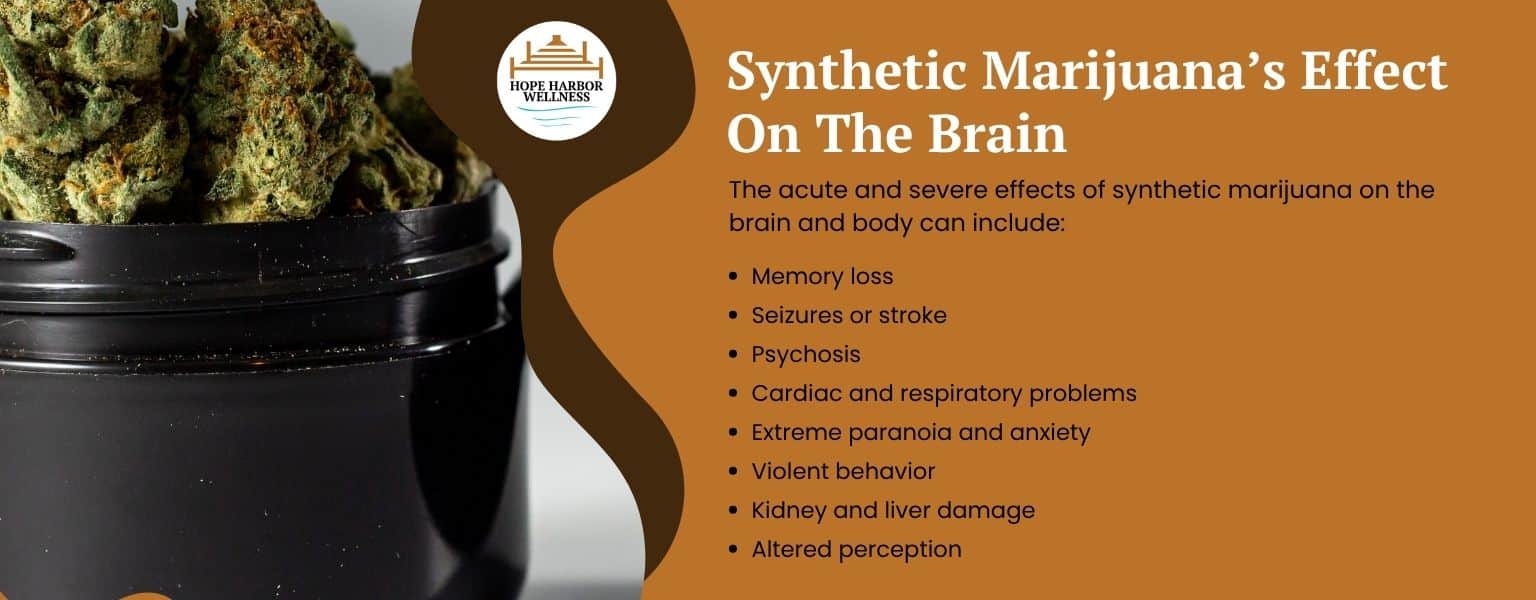
The acute and severe effects of synthetic marijuana on the brain and body can include:
- Memory loss
- Seizures
- Psychosis, including severe paranoia and hallucinations
- Cardiac and respiratory problems, sometimes leading to heart attack or respiratory failure
- Stroke
- Extreme paranoia and anxiety
- Violent behavior, often due to severe agitation or psychotic episodes
- Kidney and liver damage
- Altered perception or intense euphoria that can quickly turn into dysphoria
In addition to these acute and dangerous symptoms, synthetic marijuana can be highly addictive. After prolonged use of synthetic marijuana, there is a strong likelihood of a significant decline in overall brain cell activity and function, alongside a concurrent increase in negative physiological symptoms similar to those listed above. The severe withdrawal symptoms upon cessation further underscore its addictive potential, making professional intervention vital for recovery.

Short And Long-Term Effects Of Marijuana Use On The Brain
Understanding the duration and nature of marijuana’s effects on the brain is essential for comprehending its overall impact. Both immediate and prolonged use can lead to distinct changes.
The immediate, short-term effects of marijuana use on the brain include:
- Difficulty judging distances: Impaired spatial perception, increasing risks, especially when driving.
- Difficulty remembering: Acute short-term memory impairment, making it hard to recall recent information or conversations.
- Fatigue: A sense of drowsiness or lethargy, even after consuming the substance.
- Confusion: Disorientation and difficulty processing information clearly.
- Paranoia: Feelings of distrust, suspicion, and believing others are out to harm them.
- Anxiety: Heightened feelings of nervousness, unease, or panic, sometimes leading to panic attacks.
- Impaired coordination: Affects balance and motor skills, increasing the risk of falls or accidents.
- Increased heart rate: A common physiological response that can put stress on the cardiovascular system.
- Altered perception of time: Time may seem to slow down or speed up.
Long-term effects, which develop with chronic or heavy use and can persist long after cessation, include but are not limited to:
- Some cognitive impairment: This can affect various aspects of thinking, problem-solving, and decision-making.
- Some memory loss: Particularly impacting verbal memory and the ability to learn new information.
- Increased marijuana tolerance: The need to use more of the substance to achieve the same effects, a hallmark of developing dependence.
- Marijuana dependence: A state where the body adapts to the presence of THC and experiences withdrawal symptoms if use is stopped.
- Increased risk of mental health conditions: Especially in vulnerable individuals, consistent use can elevate the risk of developing or exacerbating conditions like depression, anxiety disorders, and, in rare cases, psychosis or schizophrenia.
- Reduced motivation (amotivational syndrome): While debated, some chronic users report a pervasive lack of drive, interest, and goal-directed behavior.
- Respiratory issues: Though not brain-related, frequent smoking can lead to chronic bronchitis and other lung problems.
- Impact on brain structure: Some studies show thinning of brain areas involved in executive functions (like the prefrontal cortex) or decreased volume in memory-related regions, particularly with adolescent use.
- Cannabis Use Disorder: Characterized by compulsive drug-seeking and use despite harmful consequences, leading to significant impairment or distress.
Understanding Cannabis Use Disorder
When recreational cannabis use becomes problematic and impacts an individual’s life negatively, it can evolve into a condition known as Cannabis Use Disorder (CUD). This is a diagnosable medical condition, not simply a lack of willpower. CUD is characterized by a problematic pattern of cannabis use leading to clinically significant impairment or distress, as manifested by at least two of the following symptoms occurring within a 12-month period:
- Cannabis is often taken in larger amounts or over a longer period than was intended.
- There is a persistent desire or unsuccessful efforts to cut down or control cannabis use.
- A great deal of time is spent in activities necessary to obtain cannabis, use cannabis, or recover from its effects.
- Craving, or a strong desire or urge to use cannabis.
- Recurrent cannabis use resulting in a failure to fulfill major role obligations at work, school, or home.
- Continued cannabis use despite having persistent or recurrent social or interpersonal problems caused or exacerbated by the effects of cannabis.
- Important social, occupational, or recreational activities are given up or reduced because of cannabis use.
- Recurrent cannabis use in situations in which it is physically hazardous.
- Cannabis use is continued despite knowledge of having a persistent or recurrent physical or psychological problem that is likely to have been caused or exacerbated by cannabis.
- Tolerance, as defined by either a need for markedly increased amounts of cannabis to achieve intoxication or desired effect, or a markedly diminished effect with continued use of the same amount of cannabis.
- Withdrawal, as manifested by either the characteristic withdrawal syndrome for cannabis, or cannabis (or a closely related substance) is taken to relieve or avoid withdrawal symptoms.
The development of CUD highlights the addictive potential of cannabis, especially with high potency strains and frequent use. Seeking professional help for CUD is a crucial step towards recovery and regaining control over one’s life.
Comprehensive Outpatient Marijuana Addiction Treatment in Atlanta
While cannabis use is often perceived as a benign activity, when it leads to dependency, negative health effects, or interferes with daily life, it becomes a serious concern. Hope Harbor Wellness offers specialized outpatient addiction treatment in Atlanta, GA, providing a vital lifeline for those struggling with substance use, including problematic cannabis use. Our programs are designed to empower individuals to break free from the cycle of marijuana addiction without requiring a residential stay, allowing clients to maintain their work, family, and educational commitments.
Stopping problematic substance use can be incredibly difficult, especially when faced with withdrawal symptoms, intense cravings, and environmental triggers. If you or a loved one are struggling to reduce or stop cannabis use, or are experiencing its negative effects, professional addiction treatment may be essential. Our outpatient drug rehab programs provide a structured yet flexible path to recovery.
At Hope Harbor Wellness, we understand that recovery is not a one-size-fits-all journey. Our outpatient addiction treatment in Atlanta focuses on helping individuals:
- Identify and manage triggers: We equip clients with strategies to recognize and navigate situations that might lead to substance use, effectively preventing relapse.
- Develop healthy coping mechanisms: Through evidence-based therapies, clients learn constructive ways to deal with stress, emotions, and cravings without relying on substances.
- Address underlying issues: Often, substance use is a way to cope with unresolved trauma, mental health conditions like anxiety or depression, or other life challenges. Our integrated approach addresses these co-occurring disorders simultaneously, fostering holistic healing.
- Rebuild cognitive function: For those experiencing memory or concentration issues due to prolonged cannabis use, therapy can include cognitive remediation techniques to help restore brain function over time.
- Build a strong support system: Group therapy and peer support are integral to our programs, fostering a sense of community and shared understanding.
Our team of experienced and compassionate professionals utilizes a range of therapeutic modalities to support patients in their recovery journey. Through individual counseling, group therapy, and educational sessions, clients learn and understand what they need most to achieve lasting sobriety.
For some individuals, medications can play a role in reducing cravings or managing withdrawal symptoms, making the initial stages of recovery more comfortable. Additionally, cannabis detox is an essential first step for many, safely eliminating toxins from the body and returning it to a healthier state under medical supervision, if necessary. No one needs to struggle with addiction alone. If you are ready to reclaim your health, your mind, and your future, contact Hope Harbor Wellness in Atlanta, GA, at 770-573-9546 or fill out our online contact form today. Our outpatient drug rehab programs are here to guide you toward a life of lasting recovery and clarity.
Frequently Asked Questions About Marijuana and Brain Health
Does using marijuana truly kill brain cells?
Current scientific evidence does not show that marijuana directly “kills” brain cells in the way that some other harmful substances might. However, prolonged or heavy marijuana use, especially during adolescence, can significantly affect brain function, activity, and connectivity, potentially leading to long-term cognitive impairments.
Can cannabis cause permanent brain damage?
While it may not cause immediate “brain damage” in the traditional sense, heavy and chronic cannabis use, particularly when started at a young age (before age 25), has been linked to structural and functional changes in the brain. These changes can affect memory, learning, attention, and executive functions, and some cognitive impacts may be persistent or potentially permanent.
Does smoking pot lower your IQ?
Research indicates that consistent marijuana use during adolescence, when the brain is still developing, can be associated with a measurable decline in IQ points that may not be fully recovered even after stopping use. For adults who begin using marijuana after brain development is complete, significant IQ loss is less commonly observed.
What are the biggest risks of THC to a developing brain?
The developing brain (up to around age 25) is highly vulnerable to THC. Risks include impaired memory, learning difficulties, reduced attention span, problems with problem-solving and decision-making, and increased susceptibility to mental health issues like psychosis, especially with high-potency products.
Is synthetic marijuana more dangerous than natural cannabis?
Yes, synthetic marijuana (like K2 or Spice) is far more dangerous. It contains unknown chemicals that bind much more potently to brain receptors than natural THC, leading to severe and unpredictable side effects such as seizures, psychosis, heart problems, kidney damage, violent behavior, and even stroke. It can also be highly addictive.
What are the common signs of marijuana addiction (Cannabis Use Disorder)?
Signs include using more marijuana than intended, persistent desire to cut down but failing, spending a lot of time obtaining or using it, strong cravings, neglecting responsibilities, continuing use despite problems, giving up important activities, using in hazardous situations, and experiencing tolerance or withdrawal symptoms.
Can outpatient drug rehab in Atlanta help with marijuana addiction?
Absolutely. Outpatient drug rehab programs, like those at Hope Harbor Wellness, provide effective treatment for marijuana addiction. They offer therapy, skill-building, and support while allowing individuals to live at home and manage daily responsibilities. This approach helps address cravings, develop coping mechanisms, and tackle underlying issues.
What kind of support does Hope Harbor Wellness offer for cannabis use issues?
Hope Harbor Wellness offers comprehensive outpatient addiction treatment in Atlanta. Our services include individual and group therapy, education on addiction and brain health, relapse prevention planning, and addressing co-occurring mental health conditions. We provide a supportive environment for long-term recovery.
How do I know if I need help for my marijuana use?
If your marijuana use is causing problems in your relationships, work, school, health, or financial situation, or if you find it difficult to stop despite wanting to, it might be time to seek professional help. Recognizing these signs is the first step toward recovery.